
The root cause hiding in plain sight
Recurrent talotarsal joint displacement (RTTJD) is a commonly overlooked instability of the joint complex that connects the ankle to the foot. When this foundation is unstable, the effects can ripple throughout the foot and lower body.
Dynamic clinical demonstration of the foot transitioning from corrected alignment into recurrent talotarsal joint dislocation.
Instability at the foundation of the foot
The talotarsal joint complex is where the talus (the bone at the top of the foot) meets the bones below it. It absorbs load and guides motion with every step.
In RTTJD, this joint repeatedly falls out of its stable, aligned position — particularly under weight-bearing load. Rather than a single dramatic event, it is a recurrent, partial displacement that can persist unnoticed for years.
Because RTTJD involves abnormal joint motion, the instability may be less apparent during a non-weightbearing examination or on non-weightbearing radiographs. Dynamic evaluation and weightbearing imaging can help reveal abnormal talotarsal joint alignment.
A dynamic problem that hides during a non-weightbearing examination
Recurrent talotarsal joint dislocation (RTTJD) is a dynamic condition that may be overlooked during a non-weightbearing examination. When the foot is subjected to weightbearing forces, abnormal talotarsal joint alignment and instability may become more apparent. Evaluating the foot under load is essential to understanding the underlying mechanics of this condition.
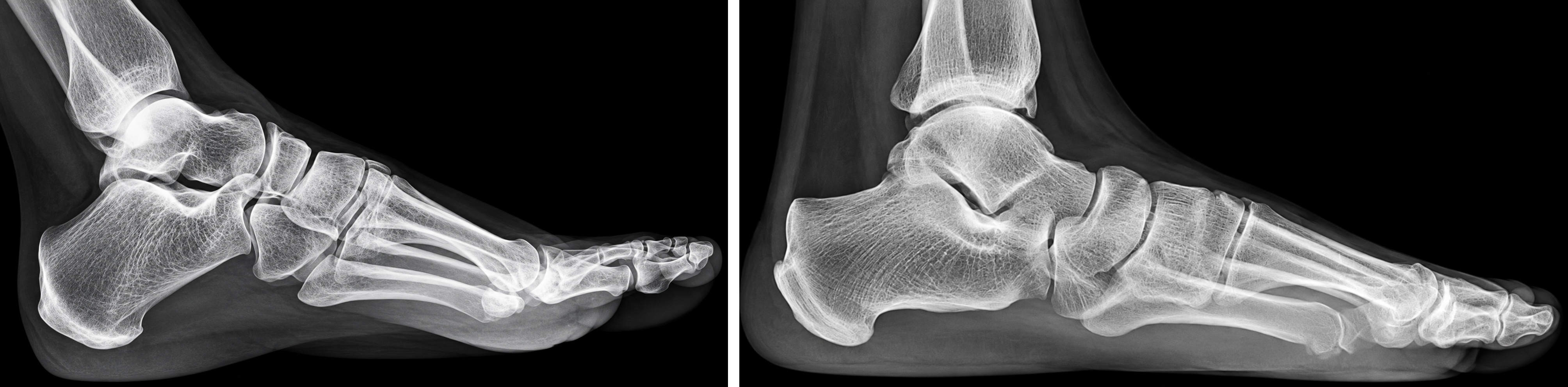
Weightbearing evaluation may reveal changes in foot alignment that are less apparent during a non-weightbearing examination. Evaluating the foot under load can help identify underlying talotarsal joint instability.
- Overpronation
- Plantar fasciitis
- PTTD
- Bunions
- Flatfoot deformity
- Foot fatigue
- Ankle instability
- Heel pain
These findings and conditions are often evaluated and treated individually. However, underlying talotarsal joint instability may be a contributing factor in some patients. Identifying RTTJD allows clinicians to consider whether abnormal talotarsal joint mechanics are contributing to the patient's symptoms and associated foot pathology.
When the foundation moves, the whole chain feels it
The foot is the base of the body's kinetic chain. Instability at the talotarsal joint may contribute to compensations that extend well beyond the foot itself.
Overpronation
Excessive inward roll of the foot as the talotarsal joint loses stable alignment during gait.
Foot fatigue & pain
Soft tissue and plantar structures work harder to compensate, contributing to aching and fatigue.
Progressive flatfoot
Sustained malalignment may contribute to arch collapse and adult-acquired flatfoot deformity.
Ankle instability
Altered joint mechanics can affect stability higher in the ankle and hindfoot.
Knee, hip & back strain
Malalignment at the foundation may transmit abnormal forces up the kinetic chain.
Altered posture & gait
The body adapts around instability, sometimes reinforcing the underlying problem over time.
Seeing instability in motion
Identifying RTTJD often depends on evaluating the joint under real, weight-bearing conditions rather than at rest. Dynamic and weight-bearing imaging can help reveal excessive talotarsal motion that a static study may not capture.
Addressing the cause, not just the symptoms
The Phoenix platform was designed to internally stabilize the talotarsal joint while preserving its natural motion. See how the approach compares — or find a Phoenix-trained provider near you.
This page is for general education only and is not medical advice. Talk with a qualified healthcare professional about diagnosis and treatment options.